The physics of sound
- Tia Leoni Lewis
- Nov 20, 2015
- 8 min read
What is sound?
Sound is a form of vibrations. We hear it, animals hear it, and anything that can detect sound will hear sound. It is a form of a longitudinal wave (also known as a mechanical wave and a pressure wave) that is energy being transported through air or water. It is transported in a compressional and refractional form. The wave lengths will go close together and then far apart. If you think of a slinky, when you push on one side repeatedly then you can see the energy being transmitted, this is the same for energy from a wavelength I n the air or any other particles such as water and steel and any other compound. Sound also travels in a circle.
Frequency?
What does frequency mean?
Well frequency is the rate at which per second a vibration in a waveform, either a material (sound waves) or in an electric magnetic field (radio waves and light).
In sound this means how many times a wave will compress and refract per second.
You can also get a sound waves with different styles of frequency. You can get a wave that is a square, a triangle, a saw tooth, and a sine (which is the smooth one).
Another thing is that everything has a frequency level. A glass cup has its own frequency. A wine glass, if you wet your finger slightly with a different amount of water in it and then run your finger around the rim of the glass, then you will hear a high pitch sound coming from the glass. Depending on how much water is in the wine glass, will depend on how high or low the pitch will be. The less water in the glass the higher the pitch, if the glass is filled half way full the pitch will be medium to low, then if you fill the glass up the whole way then you will hear an outcome sound of low pitch. It will also depend on how big the glass is to what sound it creates. The smaller the wine glass may create a more high pitched sound, the bigger the wine glass the lower pitched sound it will create.
You can also get a thin glass with no water in it and then play high pitch frequency sound from a speaker close to the glass, and then the glass will reach its limit of frequency level and will eventually smash.
Amplitude
“The maximum extent of a vibration or oscillation, measured from the position of equilibrium” (google, n.d.)
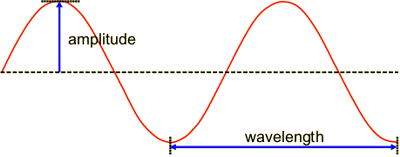
This means that the longer the wavelength the lower the pitch. The higher the wavelength the higher the pitch will be. The amplitude determines how loud the sound will be. Greater amplitude means the sound will be louder. And depending on the wavelength the pitch will be higher or lower.
This is a diagram of a wavelength and the amplitude.
There is a way you can change the amplification for guitars or anything through a amp. This is by defining the things you want to be heard by making it louder and amplifying it. This is the reason why amps are made. For example, an electric guitar you would not be able to hear that properly without an amp without it being in a very silent room. The amp will amplify the sound of the electric guitar so that you can hear the actual sound that it is producing, while you can also pick out the bits you really want to hear.
Wavelength
In physics the wavelength of a sound wave is a spatial period of the wave. The distance of which the waves shape repeats and the inverse of the spatial frequency. Spatial frequency refers to the level of details in the stimulus per degree of visual angle. A science with a small detail and a sharp edge contains more high spatial frequency information than one composed of large course stimuli. (google, n.d.)
You can get many different types of wavelengths. A square, a triangle and a sore tooth waveforms.
The main wave form is a sine. This is nice sounding sound and smooth. Another is the triangle which is more ridged and sharp. Another is the square waveform and this is my opinion sounds distorted and blocky and the saw tooth waveform is fast and unpleasant.
These wave types moves the speaker in a way that lets us hear the different sound it creates.
We hear sound differently because of these properties. If a wavelength is more close together and the amplitude is high then we hear a high pitch loud sound. If the wavelength is further apart and smaller then we hear a quiet low pitch sound. The frequency determines the pitch, the amplitude determines the volume and the wavelength.
Constructive and destructive interference
“The interference of two or more waves of equal frequency and phase, resulting in their mutual reinforcement and producing a single amplitude equal to the sum of the amplitudes of the individual waves.” (google, n.d.)
Constructive interference is when you record something say if you are using pro tools then you will hear only what you want to hear. This will sometimes sound good. Better in some cases. “This occurs at any location along the medium where the two interfering waves have a displacement in the same direction.”
Destructive interference is bad. This is where because the wave forms are facing opposite directions they don’t come together and the balance is off, which when we okay it back we hear no sound. The sound is cancelled out. “This occurs at any location along the medium where the two interfering waves have a displacement in the opposite direction.”
(the physics cclassroom, n.d.)
An example of constructive interference is when you record something into a program, such as a guitar chord and the wave length is the same pattern.
Destructive interference is when you have a guitar chord recorded, you then flip the signal/wavelength and it is cancelled out and there is no sound.
Standing waves
“A vibration of a system in which some particular points remain fixed while others between them vibrate with the maximum amplitude” (google, n.d.)
A standing wave is also known as a stationary wave it is a wave in the medium in which each point on the axis of the wave has an associated constant amplitude. The locations at which the amplitude is minimum are called nodes, and the locations where the amplitude is maximum are called antinodes.
This can occur when the opposing waves combine to make a standing wave. The medium moves in the opposite direction to the wave or this can be altered by two wave’s interference of moving it opposite directions.
“The most common cause of standing waves is the phenomenon of resonance, in which standing waves occur inside a resonator due to interference between waves reflected back and forth at the resonator's resonant frequency.” (wikipedia, 2015)
When waves travel in the opposite direction they have an equal amplitude. There are two types of standing waves. The first type of standing wave is standing waves form in the atmosphere in the lee of mountain ranges. These waves are often exploited by glider pilots.
Standing waves and hydraulic jumps also form on fast flowing river rapids and tidal currents.
These waves although are not sound waves but they do have a similar aspect on the way they move and interact.
An example of a second type of standing wave, in a transmission line is a wave in which the distribution of current, voltage, frequency etc. is formed by the superposition of two waves of the same frequency propagating in opposite directions. The outcome is a series of nodes and antinodes which is the amplitudes of wavelengths/waves at fixed points along transmission line. This standing wave may be formed when a wave is transmitted into one end of transmission line and is reflected from the other end by impedance mismatch. If the line does not transmit power at the standing wave frequency then the frequency result will be distortion of sound.
Sound pressure levels
What is sound pressure levels? Sound pressure, also known as acoustic pressure, levels also have an effect on the pressure around you. When sound travels in the air it moves particles in the air which then transmits sound into our ears which we then detect. Sound can also be produced by speakers, and also be detected by microphones. This is because when sound is transmitted from a computer into and out of the speakers the speaker woofer, it pulses when sound it transmitted through it and this determines what type of weave it is and how loud it is and what pitch it is. High frequency is also transmitted through the tweeter.
Sound pressure is the local pressure deviation from the ambient atmospheric pressure, caused by a sound wave. In air sound pressure can be measure by a microphone and in water in a hydrophone. The SI unit of sound pressure is the Pascal. In a sound wave, the complementary variable to sound pressure is the particle velocity. Together they determine the sound intensity of the wave.
Human hearing also has sound pressure levels which will damage the ear if listened to at the wrong decibels for a long or short period of time. This is also bad because if the sound goes over the decibels that our hearing loss occurs which is 20htz to 20khtz, then our hearing will be damaged, we might not lose hearing fully but it can have a catastrophic effect on how we hear in the future, even if you don’t have the effects of hearing loss straight away.
]
Sound travelling through different media/materials and how speed of sound can be altered
When sound is traveling through different materials its speed is also changed. Here is a diagram of the speed of sound through different objects.
Material
Speed of Sound
Rubber
60 m/s
Air at 40oC
355 m/s
Air at 20 oC
343 m/s
Lead
1210 m/s
Gold
3240 m/s
Glass
4540 m/s
Copper
4600 m/s
Aluminium
6320 m/s
The reason in which the speed is altered because every compound / objects has a different density. Gas particles are less close together and not very compact, whereas in a solid or liquid they are closer. The object that the particles are at their closest is in a solid. Such as steel. The speed of sound in steel is 6100m/s. this is because the particles are quicker at transmitting energy from one to the other which allows the sound to travel at a faster speed. (NDT resource center, 2015)
The speed of sound is around 343 mp/s. this can be altered by the different material that it can be transmitted through. For example sound travels faster through steel than through air because the particles in a block of steel are closer together than the particles in air. We will also have different density it different environments. Sound will also travel differently through water than steel and air. This is because of particles too.
Sound travels through a block of steel at a speed of 6100m/s. and through water it travels at a speed of 1433.
There are particles in everything and atoms. Energy is transferred from a source by these particles whether it be in steel air or under water, sound is being passed through these particles. The reason the different materials have different speed sounds is because they all have different density. Density is how compact something is in a substance.
Exploration of the harmonic and non-harmonic characteristics of sound
Harmonic characteristics of sound is a series of all multiples of base frequency. An example of this is when you creating the harmonic series you add on the bass fundamental frequency level. Here is an example:
Fundamental frequency
220 htz
2n
440 htz
3n
660 htz
4n
880 htz
5n
1100htz
A non-harmonic characteristic is when you have frequencies that don’t match the fundamental frequency. If you have 220 htz you would then add a random number which could make the next tone up from that a 310 but then they may not match a so und of or 379. Because it isn’t adding on the fundamental frequency it would not possess harmonic tones. This would also be a very harsh sound. The notes would not combine to create a nice out coming sound, they would clash and be awful.
Bibliography
google. (n.d.). Retrieved from https://www.google.co.uk/#safe=strict&q=meaning+of+amplitude
NDT resource center. (2015, 10 23). Retrieved from https://www.nde-ed.org/EducationResources/HighSchool/Sound/speedinmaterials.htm
the physics cclassroom. (n.d.). Retrieved from http://www.physicsclassroom.com/class/waves/Lesson-3/Interference-of-Waves
wikipedia. (2015, 10 23). Retrieved from https://en.wikipedia.org/wiki/Standing_wave



Comments